Economy and finance
Under the province runs a real economy, and every rand of it is posted to double-entry books. The Economy tile opens the finance workspace at its overview; Finance & tax opens it at the Mutual Bank. Nine sections run down its rail:
| Section | What it holds |
|---|---|
| Overview | GDP, prices, jobs, money and the circular flow |
| Micro | Supply and demand, the labour market, Engel's law, consumer choice |
| Macro | AD–AS, Phillips and Okun, GDP three ways, credit, inequality, the fiscus |
| Transport | Fuel prices, the Monetary Policy Committee, fares, e-hailing, Unity Transit, the airport |
| Books | Any entity's journal, ledgers and statements |
| Mutual Bank | Deposits, loans, IFRS 9 staging, prudential returns, dividends |
| Burial society | The scheme's surplus process (see The burial society) |
| Tax & SARS | PAYE, UIF, SDL, VAT, company tax, returns, assessments, compliance |
| Audit | The hash-chained journal, the articulation checks, the audit log |
The books open on the province's first day, and everything here is read from them: national figures are the sums of the households and firms you can open.
Overview
Headline figures: GDP (nominal, monthly, by the production approach) and its real growth on the year; inflation on the year against the 3% target; the repo and prime rates and the output gap; unemployment (the unemployed over the labour force); deposits and loans at the Mutual Bank and credit growth; tax revenue for the month, with government spending and the transfer from the national fiscus that funds any shortfall; and the Gini coefficient of income and of wealth, with the saving rate.
Cards: Output (nominal, real and potential GDP), Prices and the policy rate, the Circular flow of income over the last twelve months (payments between households, firms, the bank, government and the rest of the world), the household income distribution, occupations, and employment and poverty month by month.
Potential output grows with the working-age population and trend productivity, and is pulled a little toward realised output each month; the output gap is real GDP's distance from it, within ±20%.
Micro
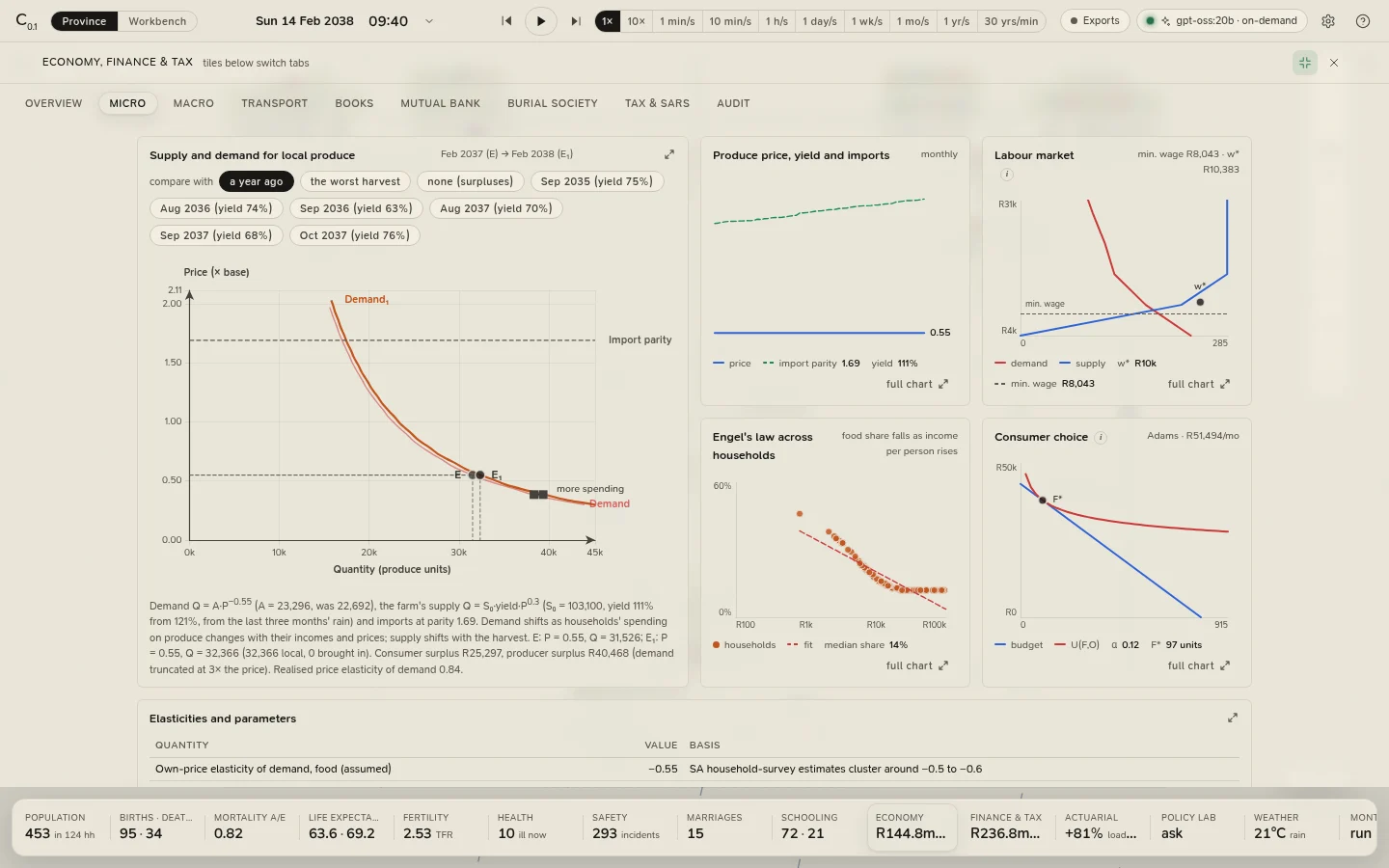
Supply and demand for local produce draws the market the way the textbook does, for this month (E₁) against an earlier one (E): both curves for both months, the equilibria, an arrow for each curve that moved (with its cause: a poorer or better harvest, more or less spending), and import parity as the ceiling on the price. compare with chooses the earlier month: a year ago (the default), the worst harvest, a recent drought month, or none, which shows the single month with consumer and producer surplus shaded. Demand has a price elasticity of −0.55; the farm's supply rises with the price (elasticity 0.3) and with the harvest's yield.
Below it: Produce price, yield and imports month by month; the Labour market, the jobs on offer against the people willing to take them at each wage, with the minimum wage as the floor; Engel's law across households, the food share of spending against income per person, fitted by least squares; Consumer choice, a household's budget line and indifference curve (pick the household); and the elasticities the market has shown.
Macro
Aggregate demand and aggregate supply: the latest quarter (E₁) against an earlier one you choose under shift from (four quarters back by default), with short- and long-run supply. GDP by the three approaches: production, expenditure and income, with the statistical discrepancy between production and expenditure stated rather than hidden (income equals production by construction).
Then the Phillips curve and Okun's law, each fitted by least squares on the quarters so far; Money and credit; Prices and wages; Lorenz curves of income and wealth; a Laffer curve (every marginal tax rate scaled from nothing to double, with an elasticity of taxable income of 0.25); the Fiscal position by tax head against spending; and the quarterly national accounts.
The Monetary Policy Committee meets every second month. Its six members each read a Taylor rule (2.5% + expected inflation + 1.5 × the gap to the 3% target + 0.5 × the output gap), lean a little hawkish or dovish, smooth toward the current rate and vote in steps of 25 basis points (50 when the rule is far away); the step most members favour carries. Prime is repo + 3.5%.
Transport
Getting about costs money, and here is where it goes. Headline figures: the pump price of 95 unleaded inland, the repo rate and the committee's last vote, the fuel levy, Hamba's rate card, the number of driver-partners, Unity Transit's fare-box recovery and the airport's traffic.
Cards: the pump price, built up (the basic fuel price from Brent and the rand, the general fuel levy net of any relief, the RAF and carbon levies, the slate levy and the margins); oil and the rand; fares against the CPI (a 3 km trip by each mode); the e-hailing market, demand against the drivers' capacity and the surge that clears it; what a driver-partner takes home, against their reservation wage; how Hamba set this month's fares; how the carless get about (the share of each mode); what households spend on getting about; Unity Transit, its costs, fares and operations grant, and its fare-box recovery against the 50% test that decides whether it counts as a market producer; the airport; fuel levies; Unity Fleet Rentals; the Monetary Policy Committee's meetings and votes; and fuel-levy relief.
The books
Every economic entity keeps its own books: every household, the shops and the mall, the farms, the workshops, the offices and chambers, the churches, the burial society, the Mutual Bank, the transport operators, the airport company, the government and the rest of the economy.
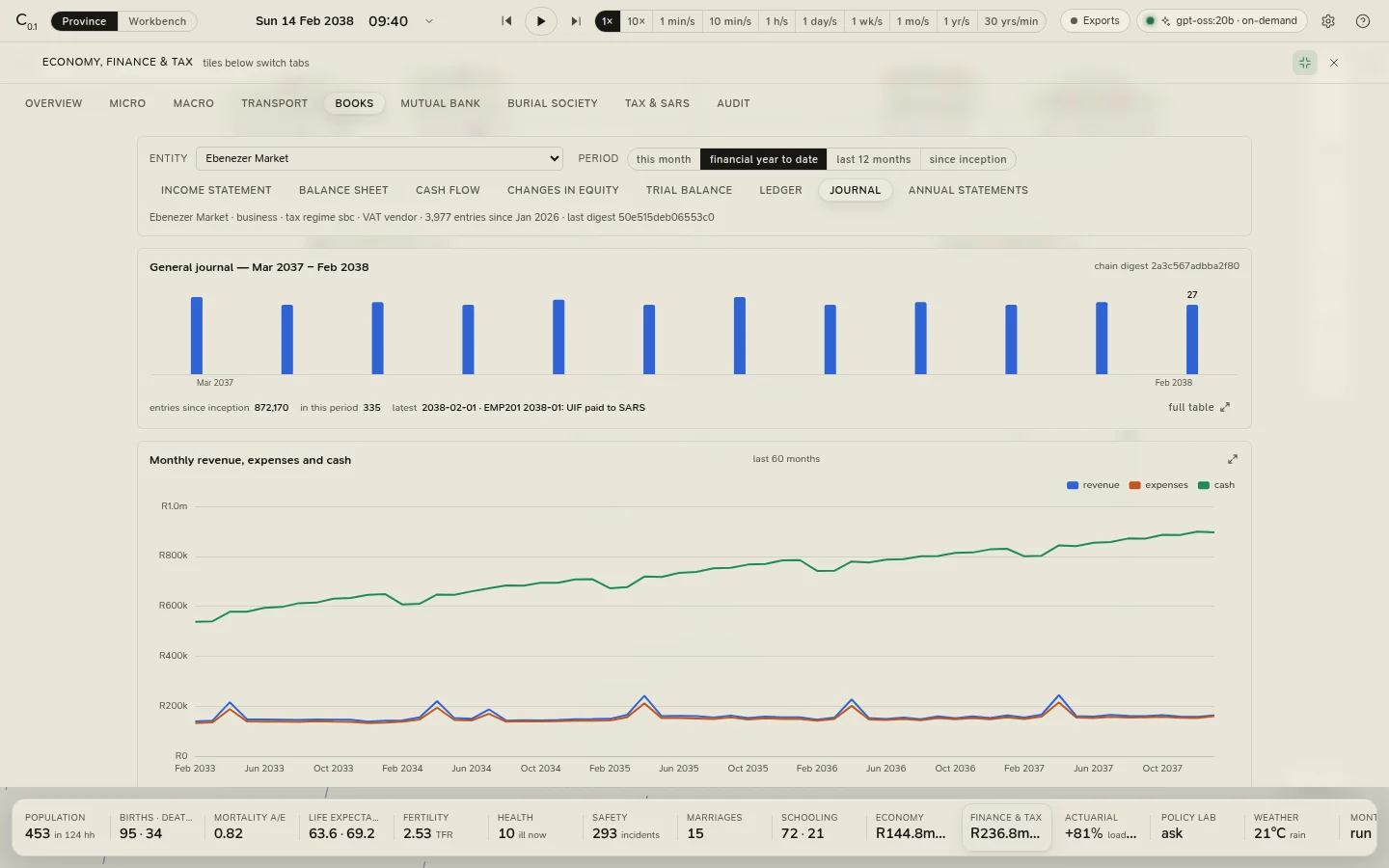
- Entity chooses whose books (the Mutual Bank by default). Period chooses this month, financial year to date (the default), last 12 months or since inception.
- Statements: Income statement, Balance sheet (the statement of financial position), Cash flow (direct method, IAS 7 classes), Changes in equity, Trial balance, Ledger (any account, with its running balance), Journal (searchable by narration, reference or account) and Annual statements (every closed year of assessment).
- The balance sheet, trial balance and ledger are always as at now; the period applies to the others.
The chart of accounts is a standard one: 1xxx assets, 2xxx liabilities, 3xxx equity, 4xxx revenue, 5xxx expenses. Statements are presented on IFRS for SMEs lines. The financial year is the South African year of assessment, March to February; at the close, revenue and expenses are carried to retained earnings and the year's statements are filed.
One journal, chained. Every entry, in every entity's books, goes into one general journal, and each entry carries a digest (64-bit FNV-1a) of its own content and of the entry before it, so any change to a past entry breaks the chain from there on. The journal keeps 36 months in full; older months keep their digests and the ledger balances. Every payment posts both sides, the payer's and the payee's, and an entry that does not balance is refused.
The Mutual Bank
The province's own bank, under the Mutual Banks Act: deposits from members, loans to households and businesses, and the returns a regulator would see. Headline figures: member deposits, loans and advances, capital adequacy, liquid assets, non-performing loans, the net interest margin and return on equity, and the year to date.
Cards: the statement of financial position (with open the bank's full books), the income statement, deposits and advances, interest income, expense and impairment, the loan book (the forty most recent loans, active first, with their IFRS 9 stage and days past due; click one), its amortisation schedule, the quarterly prudential returns to the Prudential Authority, and members' shares and dividends.
- IFRS 9 staging: stage 2 from 30 days past due, stage 3 from 90; expected credit losses at 4.5% × 60% (stage 1), 28% × 60% (stage 2) and 60% (stage 3); written off at 180 days.
- Capital on Basel I weights, at least 10% of risk-weighted assets plus a 2.5% buffer; liquid assets at least 5% of deposits; a single exposure above 25% of capital is a breach.
- Rates: deposits at repo less 4.5% (at least 0.5%), personal loans prime + 5%, emergencies prime + 4%, business prime + 2%; treasury bills at repo less 0.25%.
Tax and SARS
Headline figures: tax collected since the start; PAYE, UIF and SDL; VAT and company tax; fuel levies, rates, fines and dividends tax; compliance (taxpayers in arrears, by name); the year of assessment.
Cards: tax revenue by head, the year to date by head, the SARS tables in force (the 2026/27 tables, indexed in later years by the province's own CPI), progressivity (every assessed taxpayer's average rate against the statutory schedule), taxpayer compliance, the register of returns filed (EMP201, VAT201, IRP6, ITR14, TT03, ITR12; filter by type or taxpayer), and the individual (ITR12, each July for the year ended in February) and business (ITR14, TT03) assessments.
EMP201 is filed monthly and VAT201 every second month; provisional tax is paid in two parts. A payment made late draws a 10% penalty, interest at the prescribed rate (repo + 3.5%) runs on what is outstanding, and the taxpayer is non-compliant until it is cleared.
Audit
Headline figures: the number of journal entries and books, articulation (books whose statements fail to articulate), the hash chain (intact, BROKEN or not verified) and the chain's latest digest.
- Verify the journal: verify chain recomputes every retained entry's digest from the one before it and checks the chain ends at the latest digest; a break names the first bad entry. Below it, the month-end digests of the last eighteen months.
- Articulation of the statements by book: for every book, whether its trial balance balances, its balance sheet balances and its cash-flow statement reconciles; and whether the bank's books agree with its members' (deposits and loans, to within 5c).
- Audit log, and the standards and sources behind the books, the tax and the bank.
From a person or a household
A person's inspector card shows their payslip and their SARS position. A household's shows its accounts for the month, with open the ledger (its books, at its deposit account) and tax. The Mutual Bank's building opens the bank's books.