The actuarial workbench
The Actuarial tile opens an actuarial workbench on the province: the theory of interest, life contingencies, the burial society priced and its risk measured, a projection of the population, a worker's pension and the state's old-age grant, in the International Actuarial Notation and valued at a rate you choose from the province's own. Nothing here feeds back into the simulation: the workbench values what the province has produced, on the province's own basis.
The rail and the rate
Eight sections run down the rail: Overview, Interest, Life contingencies, Pricing, Risk & solvency, Projections, Retirement & grants and Standards. At the end of it sits the valuation rate i, which every present value in the workbench uses:
| Choice | The rate |
|---|---|
| T-bill (the default) | The treasury-bill rate the Mutual Bank earns: repo less 0.25%. The nearest thing the province has to a risk-free rate. |
| repo | The Reserve Bank's repo rate, as the province's committee set it. |
| prime | Repo + 3.5%. |
| deposit | The Mutual Bank's deposit rate: repo less 4.5%, at least 0.5%. |
| real | Treasury bills less inflation: (1 + T-bill) / (1 + CPI inflation) − 1. |
| own | Any rate you type, from −50% to 100%. |
Beside it: v, d and δ at that rate, and inflation and the real rate. Choosing a person in the drawer's scope picker makes them the life in Life contingencies and the worker in Retirement & grants.
The table throughout is the province's mortality basis (its preset, or the table it lives on) with mortality improvement applied to today; commutation functions use a radix of 100,000.
Overview
The headline figures (the rate, e̊₀ on the basis and on experience, A/E with its interval, the society's premium against its risk, the safety loading θ and adjustment coefficient R, the reserve against the SCR, and the chance of ruin within ten years); the actuarial control cycle, specify, develop, monitor, applied to the province; the notation at a glance, every symbol with its value now; and the equivalence principle in one line.
Interest
v = 1/(1+i), d = iv, δ = ln(1+i), i⁽¹²⁾ and d⁽¹²⁾, and the real rate by Fisher.
- A timeline: an annuity-certain: choose the term (5, 10, 20 or 30 years), in arrear or in advance, and the payment; the payments are drawn on a timeline with their present value at 0 and accumulated value at n, and the caption checks AV = PV(1+i)ⁿ.
- Annuity-certain values at i: aₙ|, äₙ|, sₙ|, s̈ₙ|, (Ia)ₙ|, a⁽¹²⁾ₙ| and āₙ| for terms from 1 to 40 years.
- R1,000 accumulated over thirty years at prime, treasury bills and the deposit rate, in nominal and real terms, and under the mattress.
- A loan as a timeline: the largest loan on the Mutual Bank's book, its schedule, its yield (solved by bisection) and its value at i; then the interest and capital in each instalment.
Life contingencies
Choose the life (an age and a sex, or the person in the scope), a term (10, 20 or 30 years, or to 65), and which reserve to show (term, whole life or endowment). Sums are per R100,000.
| Figure | Convention |
|---|---|
| qₓ, μₓ, ₜpₓ | μₓ = −ln(1 − qₓ) |
| e̊ₓ, eₓ | e̊ₓ from the life table with a₀ = 0.1 and deaths at mid-year elsewhere; eₓ curtate |
| Aₓ, A⁽¹²⁾ₓ, Āₓ | Benefits at the end of the year of death; A⁽¹²⁾ and Ā under a uniform distribution of deaths: (i / i⁽¹²⁾)Aₓ and (i / δ)Aₓ |
| äₓ, aₓ, ä⁽¹²⁾ₓ | Premiums annually in advance; ä⁽¹²⁾ by Woolhouse to the first order, äₓ − 11/24 |
| A¹ₓ:n | , ₙEₓ, Aₓ:n |
| Net premiums | Term and whole life, annual and monthly; endowment, annual |
| ₜV | Prospective net premium reserve |
Cards: the life table (lₓ and dₓ), the force of mortality and the rate on a log scale, expectation of life by age, Aₓ and äₓ by age, the net premium reserve ₜV over the term, and the commutation functions Dₓ, Nₓ, Cₓ, Mₓ, with Aₓ and äₓ, from the chosen age.
Pricing
The burial society priced by the equivalence principle. Its basis: a funeral premium per covered household and a life premium per covered adult of 18 to 64, the funeral benefit and life cover, all indexed by CPI, and administration of 2% of premiums.
The pure risk premium of a covered life is its monthly probability of death, q⁽¹²⁾ = 1 − (1 − qₓ)^(1/12), times its cover (the funeral benefit, plus the life sum for an adult of 18 to 64). The implicit loading is what the society charges over the sum of the pure premiums, less 1.
- Natural premium against level premium: for a man of 25 over forty years, the natural premium each year against the level premium, with the reserve built and then drawn between them.
- The pure monthly premium by age, by sex, against the flat premium every member pays.
- Who subsidises whom: every covered household, what it is charged against its pure premium, and what a risk-rated premium would be; the most subsidised first.
- Premiums and claims by year, with the loss and combined ratios; what a claim looks like, the mix of claim sizes.
The section's notes set out IFRS 17's liability for remaining coverage and for incurred claims; for monthly cover like the society's, both are small, and the workbench describes them rather than computing them.
Risk and solvency
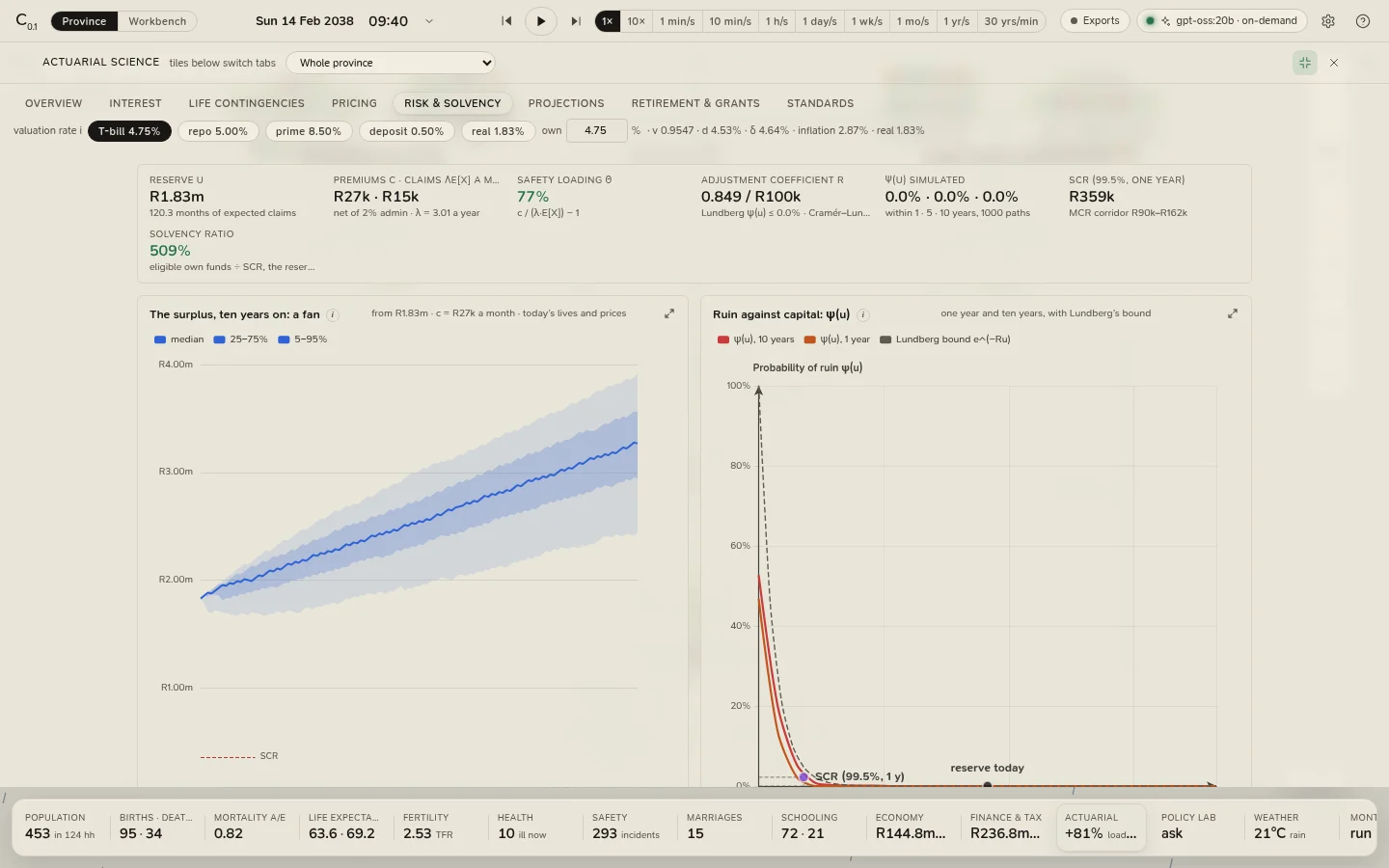
Classical risk theory on the society as it stands today: monthly premiums c, net of administration; claims a compound Poisson process with λ expected claims a month and the society's own mix of claim sizes.
- Safety loading θ = c / (λE[X]) − 1.
- Adjustment coefficient R solves λ(M_X(R) − 1) = cR (by bisection; it exists only when θ > 0). Lundberg's bound on the probability of ruin is ψ(u) ≤ e^(−Ru), and the Cramér–Lundberg approximation is C·e^(−Ru).
- The surplus, ten years on: a fan: 1,000 simulated paths of 120 months from today's reserve, in today's money and with today's lives, with their 5th to 95th percentiles; ruin is the reserve below zero at a month end.
- Ruin against capital: ψ(u) within one and ten years, simulated, against Lundberg's bound, from no capital to well past the SCR.
- The SCR: the 99.5th percentile, over the simulated paths, of the worst fall in the surplus at any month end in the next twelve months. The MCR corridor is 25% to 45% of it. The solvency ratio is the reserve over the SCR.
- Capital and premium: the fix: the capital that would meet the SCR (or a 150% ratio), and the premium that would bring Lundberg's bound to 1% at today's reserve.
- The standard formula, in the society's terms: SAM's mortality stress (+15% of a year's expected claims) and catastrophe stress (1.5‰ of the sums at risk), combined with a correlation of 0.25, beside the simulated SCR.
Projections
A cohort-component projection of the province, by single age and sex, for 10, 20, 30 or 50 years: survival on the improved table year by year, births from the fertility schedule at the basis TFR split at the sex ratio at birth, the young adults' emigration, and no arrivals. It gives the projected population, its pyramid now and at the horizon, births and deaths a year, life expectancy with improvement and the dependency ratio, and a table every five years. It is a deterministic expected path, not a simulation.
Retirement and grants
A worker's fund and pension. Choose the worker (the median earner by default, or the person in the scope), the contribution (1% to 40% of pay; 15% by default, employee and employer together) and the return: cash (the deposit rate), bonds (treasury bills + 1%), balanced (CPI + 5%, the default) or the valuation rate. Pay grows at inflation plus real wage growth until the retirement age.
At retirement the fund is split by the two-pot system: a third to the savings pot, two thirds to the retirement pot, which buys a pension, level at the valuation rate or inflation-linked at the real rate, as the retirement pot over 12ä⁽¹²⁾ at the retirement age. The replacement ratio is the pension over the final salary, and a chart shows how it moves with the contribution rate.
The old-age grant's liability. The state's grant (R2,400 a month by default) valued as a closed group, the people alive today, at the real rate: an immediate annuity for those of 60 and over, a deferred one for the rest; by age band, against GDP. It values the grant for everyone, whereas the province pays it only to those of 60 and over without an income of their own, so it is the liability if every pensioner qualified.
Standards
The standards behind each figure: the actuarial control cycle; ISAP 1 and ASSA's SAP 901; the Insurance Act and the Prudential Standards (SAM); microinsurance and the Friendly Societies Act; IFRS 17 with ISAPs 4 and 7; IAS 19 with ISAP 3 and APN 207; the Pension Funds Act, SAP 201 and the two-pot system; ISAP 2 for social security; APN 105 on AIDS mortality; ISAPs 5 and 6; and experience analysis as the CMI and SOA practise it. Then the standard formula's life module, stress by stress, and how the workbench uses each standard.